The 14th Amendment, Black History, and Why Economic Power Matters
by Atlcustoms / May 24, 2026
Latest Blogs
The King Alfred Plan aka Rex 84 (To Lock Up Minorities in Wartime or Dissension)
400 Years a Slave
Featured Businesses

The Crabby Shack
Located in Brooklyn, NY, we are “Home of The Clobster Roll”. Our menu boasts a variety of mouthwatering dishes such as our famous Crab roll, Lobster Rolls, Alaskan snow crab legs, spicy steamed shrimpView Business
 Owned by The Crabby Shack
The Black Owned Business Funding Network
Atlcustoms believes in the building, growth and development of the creative mind, entrepreneurial spirit, and the communities surrounding them. In conjunction with Black Owned Business Fundingand varView Business
 Owned by Atlcustoms
Ads
Network Sponsor Ads
this isajjjs suirfreyfr hfcduaosfi
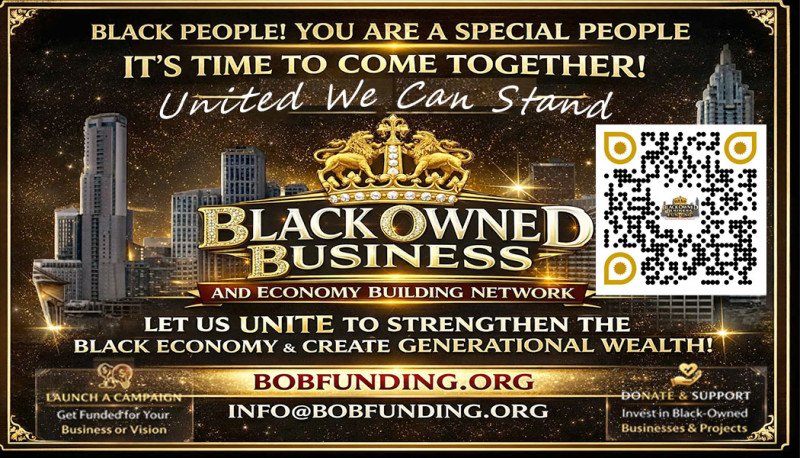
Sample Advert on the Network
Business on the network

Featured Campaigns
The Royal Awakening
Romans 13:11 ...now it is high time to awake out of sleep: for now is our salvation nearer than when we believed. The Royal Awakening is an “apocalyptic” series of educational programs andView Campaign
Owned by Atlcustoms
The Million Dollar Relief Fund
The Million Dollar Relief Fund is a community and family based campaign designed by The Black Owned Business Funding Network to provide a stimulus to black families and within the black community.TheView Campaign
Owned by Atlcustoms
Ads
Network Sponsor Ads

A Republic, A Democracy, or Both?
The United States often describes itself as the land of freedom, liberty, and democracy. Yet from the beginning, there has been a contradiction at the center of the American story.
America was founded as a constitutional republic built on representation, limited government, checks and balances, and constitutional law. At the same time, it embraced democratic ideals such as elections, citizenship, and government by the consent of the governed.
But when the nation was founded, those rights and freedoms were not equally applied to everyone.
Enslaved Africans had no constitutional rights. Native Americans were excluded from the political system. Women could not vote. Even many poor white men initially lacked full political participation depending on the state.
The original Constitution itself contained compromises connected directly to slavery, including the Three-Fifths Compromise and protections that allowed the continuation of the transatlantic slave trade.
So while America spoke the language of liberty and equality, the reality was far more limited.
The United States did not begin as a fully inclusive democracy. Instead, the meaning of American freedom expanded slowly through constitutional amendments, activism, court rulings, civil-rights struggles, and generations of resistance from people denied equal treatment under the law.
The Contradiction at the Center of America
The Declaration of Independence declared:
“All men are created equal.”
Yet slavery remained legal in the same nation making that statement.
For generations, Black Americans were forced to fight for rights that were supposedly already universal according to America’s founding ideals.
That struggle included fights for:
- abolition of slavery,
- citizenship,
- voting rights,
- equal protection,
- access to education,
- fair housing,
- labor rights,
- desegregation,
- and equal access to public institutions.
Because Black Americans faced some of the harshest legal exclusions in U.S. history, their fight for equality became one of the greatest tests of whether American democracy would truly apply its principles equally.
In many ways, the condition of Black Americans became a constitutional stress test for the nation itself. If one group’s rights could be ignored or weakened, then eventually the rights of everyone else could become vulnerable too.
Reconstruction and the Rebuilding of America
After the Civil War, the United States entered the Reconstruction era, which produced three constitutional amendments that fundamentally reshaped the country:
- The 13th Amendment abolished slavery.
- The 14th Amendment established citizenship and equal protection.
- The 15th Amendment prohibited denying voting rights based on race.
The Fourteenth Amendment was especially transformative.
It overturned the infamous Dred Scott decision, which ruled that people of African descent could not be citizens of the United States.
Section 1 of the amendment states:
“All persons born or naturalized in the United States, and subject to the jurisdiction thereof, are citizens of the United States…”
That single sentence permanently changed American constitutional law.
The amendment established:
- birthright citizenship,
- equal protection under the law,
- due process protections,
- and constitutional limitations on discriminatory state action.
Over time, the Fourteenth Amendment became the foundation for many major civil-rights victories, including:
- Brown v. Board of Education,
- school desegregation,
- voting-rights enforcement,
- and anti-discrimination protections.
Without the Fourteenth Amendment, much of modern civil-rights law would not exist in its current form.
The Backlash Against Black Advancement
Although Reconstruction created new constitutional protections, those gains were met with immediate resistance.
Southern states developed systems designed to suppress Black political and economic advancement through:
- segregation,
- poll taxes,
- literacy tests,
- racial violence,
- unequal schools,
- discriminatory housing,
- and convict leasing systems.
This revealed an important truth:
Rights written on paper do not automatically guarantee equal treatment in practice.
Black Americans technically possessed constitutional rights after Reconstruction, yet many were still denied meaningful access to political representation, economic opportunity, quality education, and legal protection for generations afterward.
Black Codes, Convict Leasing, and Economic Control
After slavery officially ended, many Southern states passed “Black Codes” designed to control formerly enslaved people.
These laws:
- restricted labor opportunities,
- criminalized unemployment or “vagrancy,”
- limited movement,
- restricted property ownership,
- and imposed harsh penalties for minor offenses.
Many historians view these systems as attempts to recreate slavery under another name.
The 13th Amendment abolished slavery “except as punishment for crime,” and many states exploited that loophole through convict leasing.
Black Americans were disproportionately arrested under vague laws and leased to private industries for labor in:
- mines,
- railroads,
- plantations,
- and industrial operations.
This system generated wealth for others while many Black communities remained economically trapped.
Jim Crow and Unequal Access to Wealth
Following Reconstruction, Jim Crow segregation enforced racial separation across nearly every aspect of American life.
Black Americans faced barriers to:
- banking and credit,
- land ownership,
- education,
- healthcare,
- infrastructure,
- and economic investment.
Policies such as:
- redlining,
- discriminatory FHA housing practices,
- unequal school funding,
- exclusion from portions of New Deal programs,
- and unequal access to GI Bill benefits
helped create long-term racial wealth disparities that continue to affect communities today.
These issues were not only social or political issues — they were economic issues.
When a people are denied equal access to land, capital, ownership, education, and investment for generations, the effects become generational.
The Civil Rights Movement and Democracy
The Civil Rights Movement of the 1950s and 1960s pushed America closer toward a more inclusive democracy.
Major victories included:
- Brown v. Board of Education,
- the Civil Rights Act of 1964,
- and the Voting Rights Act of 1965.
These were not simply “Black issues.”
They were constitutional issues.
They were democracy issues.
They were questions about whether America would fully apply its own principles equally under the law.
Why Historical Memory Matters
Modern debates surrounding education, curriculum, African American Studies, and discussions of systemic inequality reflect larger questions about how American history should be understood and taught.
History shapes identity.
History shapes policy.
History shapes economics.
Throughout American history, control over:
- education,
- voting access,
- public participation,
- economic opportunity,
- and historical narratives
has often determined who possesses power and who does not.
Understanding history is not about promoting division. It is about understanding how systems, laws, and institutions shaped present realities.
Why Economic Development Matters
Political rights alone do not automatically create economic stability.
A community also needs:
- ownership,
- businesses,
- access to capital,
- land,
- education,
- infrastructure,
- research and development,
- and strong internal economic circulation.
Many communities throughout the world strengthen themselves by investing in their own businesses, institutions, schools, infrastructure, and future generations. Economic development creates stability, opportunity, and long-term sustainability.
For Black communities, strengthening economic infrastructure is especially important because many historical barriers limited access to wealth accumulation, investment opportunities, and generational asset building for centuries.
That is why supporting Black-owned businesses, entrepreneurs, organizations, and community development matters.
Economic empowerment helps:
- create jobs,
- circulate resources within communities,
- strengthen families,
- develop future generations,
- increase ownership,
- reduce dependency,
- and build long-term community stability.
When businesses grow, communities grow.
When communities grow, opportunities expand.
When ownership increases, future generations inherit more than struggle — they inherit infrastructure, knowledge, resources, and opportunity.
Building Beyond Survival
The goal is not simply survival.
The goal is development.
The goal is sustainability.
The goal is generational empowerment.
The history of Black Americans is deeply connected to the ongoing story of American democracy itself. From slavery to Reconstruction, from segregation to civil rights, and from voting rights to economic empowerment, the struggle has always involved a larger question:
Who has full access to the promises, protections, opportunities, and resources of America?
That question remains relevant today.
Building stronger businesses, stronger institutions, stronger families, and stronger communities is not separate from democracy — it is part of participating fully within it.
Economic development, ownership, education, and community investment are all connected to the long-term ability of a people to thrive, sustain themselves, and shape their future.