Why This Matters
The Black Owned Business Funding and Economy Building Network
-
It Takes a Village
Historical Separation and Disruption
Between the 15th and 19th centuries, an estimated 12–15 million Africans were forcibly removed from their homelands through the transatlantic slave trade. These individuals were transported to regions including Brazil (≈40%), the Caribbean (≈35%), and North America (≈5–6%), with the remainder sent to Central and South America. This process did not simply relocate individuals; it intentionally fractured nations, tribes, languages, and families, permanently disrupting collective identity and economic continuity.
Upon arrival in what became the United States, enslaved Africans were systematically stripped of education, legal status, cultural practices, surnames, land ownership, and family stability. Families were routinely separated through sales, forced breeding practices, and violence. Labor assignments and perceived economic “value” further divided people by skill, complexion, and physical ability—deepening internal separation.Post‑Emancipation Economic Reality (1865–1965)
After nearly 250–300 years of uncompensated labor, emancipation in 1865 provided no land, capital, education, or institutional support. Policies such as Black Codes and vagrancy laws criminalized unemployment and homelessness—conditions created by emancipation itself—resulting in mass incarceration and forced labor through convict leasing. By 1900, over 90% of incarcerated leased laborers in Southern states were Black, reinforcing economic exploitation.
From 1865 to 1965, segregated education systems ensured that Black Americans received dramatically fewer resources. For example, in many Southern states, per‑student spending on white students was 3–10 times higher than on Black students. During this same period, Black churches, schools, and businesses were frequent targets of lynchings, bombings, arson, and political suppression, limiting collective organizing and wealth formation.Generational Wealth Gap
By the 1960s, many Black Americans gained improved access to education and employment; however, their parents and grandparents had been denied the ability to accumulate or pass down assets. In contrast, many white families inherited homes, businesses, land, and savings—often built directly or indirectly from slave labor and discriminatory policies such as Homestead Acts, FHA loans, and GI Bill benefits, from which Black Americans were largely excluded.
As of recent data:
Median white family wealth in the U.S.: ≈$180,000
Median Black family wealth: ≈$20,000
Over 70% of Black college graduates rely on student loan debt, compared to about 40% of white graduates
This lack of inherited capital limits homeownership, business formation, research and development, and long‑term economic security within Black communities.The Power of Collective Spending
Black consumers in the United States spend an estimated $1.6–$1.8 trillion annually. Cultural industries—music, sports, film, and entertainment—demonstrate how collective spending creates wealth. Artists and athletes become millionaires and billionaires through consistent, repeated consumer support, which then attracts sponsorships, investment, and ownership opportunities.
For example:
If 10% of the Black population (≈4.3 million people) spends $10, that equals $43 million.
At 30% participation, that figure rises to $129 million.
Redirected into Black‑owned businesses, infrastructure, research, and community development, this same spending power could fund:
Business startups and job creation
Healthcare and nutrition research addressing disparities (e.g., diabetes, hypertension)
Education, housing, land ownership, and community planningThe Case for Economic Unity
Globally, nations and ethnic groups sustain themselves by prioritizing internal investment, passing down assets, and protecting their economic ecosystems—while still engaging globally. Black Americans, uniquely identified primarily by race rather than nationality or lineage, were denied this continuity through enforced separation and policy.
Today, Black Americans possess the full range of professional expertise—doctors, engineers, scientists, educators, lawyers, entrepreneurs, and innovators—necessary to sustain a strong, independent economic infrastructure. The missing component is not talent or ability, but coordinated
resource circulation and collective investment.Moving Forward Together
The Black Owned Business Funding and Economy Building Network exists to address this gap by facilitating direct investment into Black‑owned businesses, entrepreneurs, and community projects. This is not positioned as a complete solution, but as a practical starting point—one that emphasizes economic development, community building, generational wealth, and taking care of our own.
History demonstrates that separation weakened economic power. Data demonstrates that collective investment builds it. Unity—applied economically—is the path forward.
A little help can go a Long Way!
The Black Owned Business Funding and Economy Building Network
orFeatured Campaigns
Highlighted Ventures and Campaigns
 Community
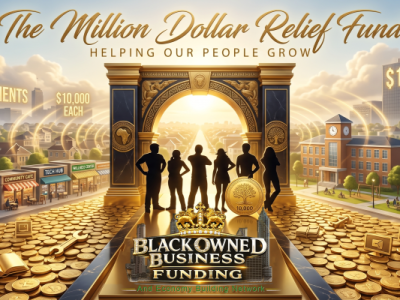
The Million Dollar Relief Fund
The Million Dollar Relief Fund Investing in Families. Strengthening Communities. Building Our Economy. The Million Dollar Relief Fund, an initiative of the Black Owned Business Funding and Economy Bui...
$ 225 0.02%raised of $1,000,000
 by Atlcustoms
No deadline
by Atlcustoms
No deadline
 Spirituality / Faith
The Royal Awakening
Romans 13:11 ...now it is high time to awake out of sleep: for now is our salvation nearer than when we believed. The Royal Awakening is an “apocalyptic” series of educational programs and...
$ 400 0.40%raised of $100,000
by Atlcustoms
No deadline
 Charity
The Black Owned Business Funding Network
Atlcustoms believes in the building, growth and development of the creative mind, entrepreneurial spirit, and the communities surrounding them. In conjunction with Black Owned Business Fundingand var...
$ 272 0.27%raised of $100,000
by Atlcustoms
No deadline